
Agent capacity planning using stress test data: From testing to infrastructure decisions
Agent capacity planning using stress test data helps CX leaders size AI infrastructure for peak load and prevent system failures.


Roy Moussa

Co-Founder, CEO @ GetVocal
Good amount to work with here. Here's a short blog author bio for Roy: Roy Moussa is co-founder and CEO of GetVocal AI, an enterprise conversational AI platform combining deterministic logic with generative AI to help organisations automate customer interactions at scale. With over a decade spent building purpose-led AI companies for regulated industries, Roy founded GetVocal in 2023 alongside his long-time co-founders after repeatedly encountering the same challenge: enterprises need AI they can actually control and audit. GetVocal reached $1M ARR in five months and has since raised €22 million in Series A funding. He is a vocal advocate for hybrid human-AI models that prioritise transparency, governance, and real business outcomes over hype. Roy Moussa holds a 2006 - 2011 Concordia University. With a robust skill set that includes Engineering, Leadership, Mechanical Engineering, Customer Service, CAD and more.
Agent capacity planning using stress test data helps CX leaders size AI infrastructure for peak load and prevent system failures.

AI agent stress testing mistakes often miss conversational logic gaps, omnichannel failures, and compliance risks in production.

AI agent testing prevents production failures that cost enterprises up to 300K in development costs and EU AI Act penalties up to 35M.

Data quality and knowledge base preparation for AI agents requires a five step audit methodology to make dirty data production ready.

Conversational AI governance requires graph-based decision maps that encode business rules, enable human oversight, and satisfy EU AI Act.

Avoiding black box AI in customer service requires transparent, auditable AI agents that meet EU AI Act compliance standards.

AI agent behavioral drift is the slow divergence between designed and actual behavior in production, caused by data and concept drift.

Conversational AI pricing for retail: compare per-seat, per-resolution, and outcome-based models to calculate true TCO and hidden costs.

Real-time monitoring and control for AI agents requires active supervision dashboards that enable live intervention and compliance.

Migrating from Gradient Labs to multi-channel AI requires four phases: audit logic, map Context Graphs, integrate voice and chat.

Octonomy pricing TCO analysis: Hidden costs, 24-month breakeven metrics, and outcome-based alternatives for enterprise contact centers.

Migrating from Salesforce Service Cloud to AI requires auditing Einstein flows, remapping to Context Graphs, and maintaining compliance.

Gradient Labs EU AI Act compliance gaps in Article 50 disclosure and audit trails expose regulated enterprises to enforcement risk.

Migrating from Octonomy to a hybrid AI-human platform requires extracting conversation logic, remapping integrations, and ensuring compliance.

Compare the best conversational AI for retail and ecommerce in 2026: governance, EU AI Act compliance and peak-season scale for high-volume CX teams.

PolyAI pricing starts at $150K plus per-minute fees. Compare the true TCO and the best alternatives, including compliance costs and hidden integration expenses.

Salesforce Service Cloud pricing TCO runs 2x to 3x beyond base licenses once Voice minutes, Agentforce AI fees, and MuleSoft costs are included.

Talkdesk pricing TCO for 200 seats runs $1.17M-$1.75M over 24 months once AI add-ons, voice usage, and support are included. See the full breakdown and alternatives.

Retell AI vs alternatives: Compare voice AI platforms on latency, CCaaS integration, EU compliance, and pricing for CX teams.

LangChain alternatives for regulated CX: compare DIY frameworks vs managed platforms on TCO, deployment speed, and EU AI Act compliance.

Salesforce Service Cloud implementation timeline for enterprise deployments realistically takes 12 to 24 months across four phases.

Salesforce Einstein EU AI Act compliance gaps in Articles 13, 14, and 50 create audit risks for regulated CX deployments.

Migrating from Talkdesk to modern AI requires a 3 to 6 month phased approach covering telephony cutover and compliance mapping.

Compare Zendesk alternatives for enterprise contact centers on EU AI Act compliance, deflection, transparent governance, and 24-month TCO.

Talkdesk EU AI Act compliance gaps in Article 50 transparency, GDPR data sovereignty, and audit trails for regulated enterprises.


Octonomy alternatives compared: EU AI Act compliance, multilingual support, TCO, and human oversight for enterprise contact centers.

LangChain observability requires custom engineering for tracing, drift detection, and compliance in regulated CX environments.

Conversational AI for banking must meet FCA, DORA, and EU AI Act requirements while achieving 60-70% deflection on key use cases.

Outcome-based pricing replaces Talkdesk per-seat costs with pay-per-resolution, reducing CPC through 70% deflection.

Salesforce Service Cloud alternatives for enterprise contact centers: compare AI platforms with EU AI Act compliance and outcome pricing.

Zendesk EU AI Act compliance gaps in Article 50 transparency and audit trails create regulatory risks for contact centers.

Switching from Zendesk requires a 16 week migration plan covering data extraction, CCaaS integration, and EU AI Act compliance.

Zendesk enterprise pricing runs $1.5M to $1.7M in Year 1 for 200 agents. Compare real TCO vs outcome-based alternatives.

Zendesk's ticket-first architecture caps AI deflection at 35% and creates EU AI Act compliance risks for regulated enterprises.

Outcome-based pricing lets you replace per-seat BPO contracts with pay-per-resolution AI that cuts costs by 75% at 50% deflection.

Replace BPO with hybrid AI human contact centers to cut costs 30% and meet EU AI Act compliance with this strategic transition guide.

European insurer replaced 200 seat BPO with 90 agent hybrid AI team in 14 months achieving 65% deflection and 30% cost reduction.

BPO cost per contact runs EUR6-8 before hidden fees. Hybrid AI delivers EUR2.04 blended rates at 60% deflection with full ROI in months.

BPO exit strategy: Execute an 18 month transition plan from offshore vendor to hybrid AI human operation with minimal CX disruption.

HIPAA compliant voice AI for healthcare contact centers requires BAAs, PHI redaction, and glass box architecture for audit trails.

Compare the best Intercom Fin alternatives for enterprise customer service in 2026: deflection rates, CRM and CCaaS integration, EU AI Act compliance, and TCO.

Conversational AI for insurance automates FNOL intake and claim status while meeting EU AI Act compliance with auditable decision paths.

AI agent vs chatbot comparison: TCO modeling, deflection benchmarks, and a decision framework for EU AI Act compliant deployments.

Best Zendesk AI alternatives for voice deflection, EU AI Act compliance, and 60 to 70 percent deflection rates in regulated industries.

Common agent stress testing mistakes include ignoring real customer flows, skipping baselines, and testing in isolation from production.

AI agent meltdown destroys contact center metrics and drives burnout. Learn to prevent hallucinations and escalation failures.

AI agent vendor evaluation requires assessing graph explainability, legacy integration depth, and EU AI Act readiness beyond marketing.

Monitoring AI agent health requires tracking conversational metrics like logic loops and sentiment decay to catch failures early.

Agent stress testing tools comparison: evaluate platforms for AI load testing, real time monitoring, and escalation accuracy.

DMS integration guide for conversational AI covers API protocols, data sync, compliance, and implementation timelines for automotive dealers.

Connecting conversational AI to TMS, WMS, and CRM systems requires bidirectional REST APIs for 60-70% deflection in logistics.

Genesys and Salesforce integration with AI agents eliminates 45+ seconds of context switching per escalated call in hybrid workforces.

12 week conversational AI implementation roadmap breaks deployment into integration, validation, and pilot phases for contact centers.

PolyAI limitations create compliance and ROI barriers for regulated contact centers in 2026. Why CX leaders switch to auditable alternatives.

Hybrid workforce models reduce agent attrition by pairing AI automation with human oversight, cutting burnout through governance.

AI agent safeguards prevent catastrophic failures through confidence thresholds, circuit breakers, and human oversight controls.

Bad training data causes AI agents to hallucinate policies, spike handle times, and push escalations onto your human contact center team.

When an AI agent fails, stabilize the floor and protect your team with clear manual fallback procedures and transparent communication.

Concurrent agent workload analysis measures how multiple AI agents perform under peak load, exposing failures in handoffs and escalations.

GDPR data sovereignty for AI contact centers requires on-premise or EU-hosted cloud deployment with glass-box architecture.

Best conversational AI for customer service handles complex calls through transparent escalation, not silent failures. Evidence inside.

AI agent meltdown statistics show 95% of AI pilots fail in production. Learn why autonomous AI systems break and how to prevent failures.

Hybrid workforce implementation takes 90-120 days for compliant AI deployment with human-in-the-loop governance and EU AI Act readiness.

Enterprise SaaS conversational AI scaling from pilot to production requires compliance architecture, legacy integration, and governance.

Why companies switch from Sierra AI: Real migration stories reveal budget unpredictability, agent burnout, and integration friction.

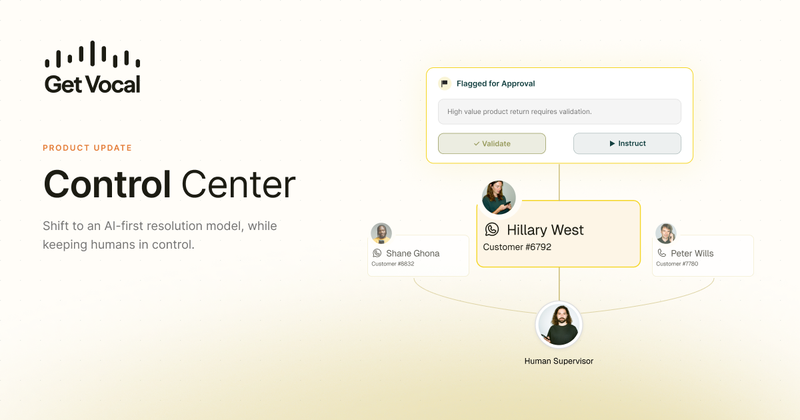
Announcing the GetVocal Control Center. Shift from a human-first contact resolution model to an AI-first model.

Hybrid AI human contact centers achieve 60-70% deflection and reduce cost per contact from EUR7-EUR12 to EUR5-EUR7 with auditable governance.

Hybrid workforce platforms combine AI agents and human agents under unified governance for EU AI Act compliance and auditable CX.

Building AI agents requires a structured 7-phase process from conversation mapping to deployment with EU AI Act compliance built in.

SaaS companies reduce support costs 40% with conversational AI by implementing governance-first architecture, not smarter LLMs.

Conversational AI automates complex retail return policies with auditable workflows, fraud detection, and human oversight for compliance.

Best conversational AI platforms for SaaS support compared on architecture, EU AI Act compliance, pricing, and integration depth.

Conversational AI streamlines dispatch communication automation by handling ETA updates, WISMO queries, and driver confirmations at scale.

Conversational AI for SaaS requires EU AI Act compliance, data residency controls, and auditable oversight beyond standard SOC 2.

Conversational AI for SaaS onboarding automates setup and activation to reduce churn and accelerate time to value for new users.

Best PolyAI alternatives for banking and insurance prioritize EU AI Act compliance, audit trails, and on-premise deployment options.

Hotels can use conversational AI for agent adoption by positioning AI as workload relief through phased rollouts and transparent governance.

Conversational AI integration to PMS and CRS connects live inventory, automates bookings, and cuts deployment to 12 weeks or less.

Conversational AI for airlines automates flight booking, rebooking, and passenger support while ensuring EU261 and AI Act compliance.

Conversational AI for multilingual support requires dialect aware NLU, compliance architecture, and human oversight across EU markets.

The true cost of conversational AI includes integration, compliance, and tuning costs that exceed licensing fees by 30-40%.


Switching from PolyAI requires a 12 week migration roadmap covering data extraction, Context Graph build, and phased go live.
Reduce average handle time with conversational AI by automating authentication, lookups, and ACW while protecting CSAT through oversight.

An honest 2026 Cognigy review: pros, cons, pricing and TCO, the real implementation timeline, and whether it fits mid-market contact centers.

Conversational AI for telecom and banking built with auditable decision paths, GDPR compliance, and human oversight at every step.

PolyAI alternatives for 2026: Compare GetVocal, Cognigy, Parloa, Genesys, and Omilia for EU compliance and enterprise contact centers.

Conversational AI compliance for retail requires GDPR, EU AI Act, and SOC 2 readiness. Protect your contact center from fines up to 35M.

Retail AI trends 2026: agentic AI, proactive support, and governance infrastructure that gives you control over autonomous workflows.

Common mistakes SaaS companies make with conversational AI deployments are often strategy errors. Avoid costly pitfalls and failed projects.

Compare the best conversational AI platforms for hospitality and tourism: multilingual guest service, PMS integration, seasonal scaling, and EU compliance.

Manufacturing customer operations AI integrates with ERP systems to automate logistics queries while agents focus on technical support.


Scale guest support during peak travel using hybrid AI operations to handle volume surges without proportional staffing increases.

Best conversational AI for automotive and industrial operations combines voice-first architecture, DMS and ERP integration depth, and compliance.

Sierra AI escalation handling compared: which platform preserves context at handoff and gives team leads real-time oversight?

Best conversational AI for SaaS companies: technical guide to platforms that integrate deeply, execute actions, and reduce churn in 2026.

Conversational AI for SaaS support: Compare chatbots, live chat, and hybrid models. Learn which solution fits your budget and needs.


Migrate from Sierra AI using a five-phase approach that protects KPIs while moving to transparent, controllable infrastructure.

Sierra AI alternatives compared for agent experience. Discover which platforms agents prefer for escalation context and workload.

Best Sierra AI alternative for mid-market contact centers needing rapid deployment, transparent AI decisions, and GDPR compliance.

Conversational AI for automotive after-sales cuts cost per interaction by 50% while deflecting 60 to 80% of routine service queries.

Compare the best conversational AI for logistics and supply chain. Automate WISMO, driver WhatsApp support, and dispatch across voice and chat.

Sierra AI implementation takes weeks to months. GetVocal reaches stable AHT and FCR in 2-3 weeks with transparent decision logic.

Cognigy vs GetVocal comparison for contact centers: compliance, voice quality, pricing, and deployment speed for regulated CX.

Sierra AI pros and cons: honest assessment of performance, voice latency, compliance gaps, and when to choose alternatives.

Compare the best Cognigy alternatives and competitors for fast deployment. GetVocal deploys in 4-12 weeks, scaling to 80 agents with a 35% deflection lift.

Best Cognigy alternatives for mid-market contact centers managing 100 to 500 agents across European markets with compliance needs.

Sierra AI alternatives compared: GetVocal AI, Cognigy, Parloa, Genesys, and NICE for contact centers needing transparent governance.

Sierra AI alternatives for telecom: compare platforms on GDPR compliance, agent burnout risk, and control over AI decisions.

GetVocal AI vs Sierra comparison for mid-market contact centers: implementation timelines, governance models, and real costs.

Common mistakes in logistics conversational AI deployment include black box logic, data silos, and missing human oversight controls.

Conversational AI for guest complaints uses deterministic graphs and real-time oversight to resolve issues while escalating complex cases.

Future of conversational AI in logistics requires agentic systems with EU AI Act compliance by August 2026 to avoid major penalties.

Measuring AI agent success in retail requires containment rate, blended cost per contact, and audit pass rate for 2026 compliance.

AI agent for ecommerce cuts support costs to under EUR3 per contact through hybrid AI human models achieving 70% deflection with 85%+ CSAT.

The future of SaaS customer operations combines agentic AI with governance for autonomous support that reduces churn and passes audits.

Conversational AI vs Traditional IVR systems: Why legacy IVR fails with rigid menus and how AI achieves 70%+ deflection rates.

Agent stress testing metrics reveal which KPIs predict system failure under load and protect your contact center operations.


AI agent quality assurance requires rigorous testing and validation frameworks to prevent catastrophic failures in production.

AI agent stress testing measures cognitive load under concurrent conversations to find breaking points before accuracy degrades.

Compare Cognigy vs GetVocal vs Zendesk for regulated contact centers. Implementation speed, compliance, and voice automation trade-offs.


Quality assurance for NSFW detection requires monitoring false positives and false negatives to protect agents while serving customers.

Reduce customer service costs 30% with AI versus traditional approaches. Compare BPO, WFM, and conversational AI economics for CX leaders.

Agent training for NSFW prevention covers prompt injection, jailbreaking, and abuse handling in AI contact centers with protocols.

PolyAI vs Salesforce Einstein comparison reveals integration complexity, voice latency gaps, and compliance risks for CX leaders.

Stress testing reveals how AI agents fail under production load, catching API timeouts and context overflows before customers do.

AI agent compliance failures trigger EU AI Act fines up to 35 million euros. Learn how to prevent regulatory risks in contact centers.

PolyAI vs GetVocal comparison for regulated customer service teams. Transparent pricing, EU AI Act compliance, and hybrid governance.


Best conversational AI for customer service combines high deflection with strict human oversight and EU compliance for regulated enterprises.


GetVocal raises $26M Series A led by Creandum to scale hybrid human-AI agents for enterprise customer experience across Europe with full transparency.


Most voice AI agents sound impressive but fail in production. Learn why prompt-heavy approaches break down and how intent-driven systems deliver reliable customer experiences.

GetVocal Signs Strategic Partnership with ellio to Launch the Next Generation of Quality AI Conversational Agents


GetVocal partners with Camunda to deliver transparent, end-to-end orchestration for customer conversations. Scale AI agents with full visibility and control.


Discover why 95% of AI agent projects fail and how to avoid the 7 critical pitfalls. Learn how hybrid human-AI systems scale trust through compliance and control.